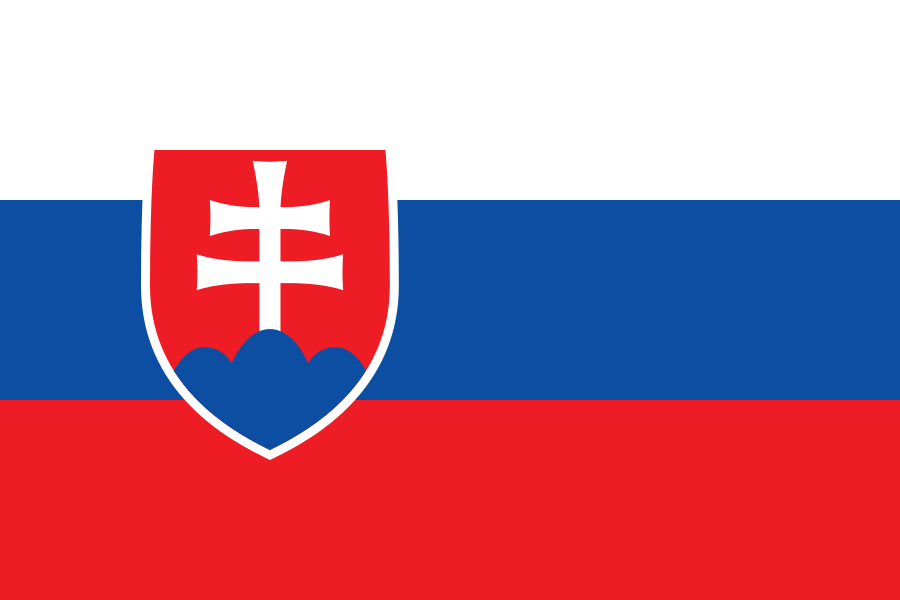
Slovakia represents a young but ambitious football nation. Created in 1993 after Czechoslovakia's dissolution, the Slovak national team quickly proved its legitimacy on the international stage. The Repre (affectionate diminutive of Reprezentácia, the national team) play at City Arena Trnava, a modern stadium that hosts home matches and offers an excellent atmosphere despite its modest capacity.
Slovakia's history peaked during Euro 2016 in France, where the team reached the round of 16 after a remarkable group stage. This historic performance, led by players like Marek Hamšík and Martin Škrtel, propelled Slovakia onto the European scene. The country also participated in Euro 2021 and the 2010 World Cup, confirming steady progress since independence.
Slovakia focuses on developing technical talents who compete in major European leagues. The country regularly produces quality players like Milan Škriniar, Stanislav Lobotka, and Juraj Kucka. The national team favors organized and tactically disciplined football, combining defensive solidity with efficient transitions. The Slovaks maintain rivalries with their Czech and Hungarian neighbors, inherited from Central European history.
FAQ
Slovakia plays its matches at City Arena Trnava and occasionally at Tehelné pole in Bratislava. City Arena, a modern 19,200-capacity stadium inaugurated in 2015, is the primary home of the Slovak national team.
Slovakia played its first official match in 1994 after independence. The historic moment remains participation in Euro 2016 where the team reached the round of 16, a major achievement for this young nation that also participated in the 2010 World Cup.
Achievements include participation in the 2010 World Cup (first round) and especially Euro 2016 where Slovakia reached the round of 16 after a remarkable group stage. The country also participated in Euro 2021, confirming its progression.
Marek Hamšík is the absolute icon, all-time top scorer and most capped player. Martin Škrtel, Milan Škriniar, Stanislav Lobotka, and Juraj Kucka are also among recent legends who elevated the national team to the highest European level.
At Euro 2016, Slovakia achieved a historic run, notably beating Russia and holding England to a draw in the group stage. The team fell in the round of 16 against Germany, but this performance marked a turning point for Slovak football.
Slovakia favors organized and disciplined football, based on solid defense and rapid transitions. The team combines tactical rigor and efficiency, seeking to compensate through collective organization what may be lacking in individual talent against greater nations.
Slovakia invests in youth development through academies of major clubs like Slovan Bratislava and Spartak Trnava. The federation also develops programs to identify talents and prepare them for professional European football requirements.
The main rivalry concerns the Czech Republic, inherited from shared Czechoslovak history. Slovakia also maintains sporting rivalries with Hungary and Austria, its Central European neighbors with whom it shares common football history.
Repre is the affectionate diminutive of Reprezentácia (national team in Slovak). This simple and popular nickname is universally used by Slovak supporters and media to designate their national team with pride.
Slovakia aims to regularly qualify for final phases of European Championships and World Cups. The objective is to confirm the progress made and regularly advance past the first round of major tournaments to establish themselves among respected European nations.