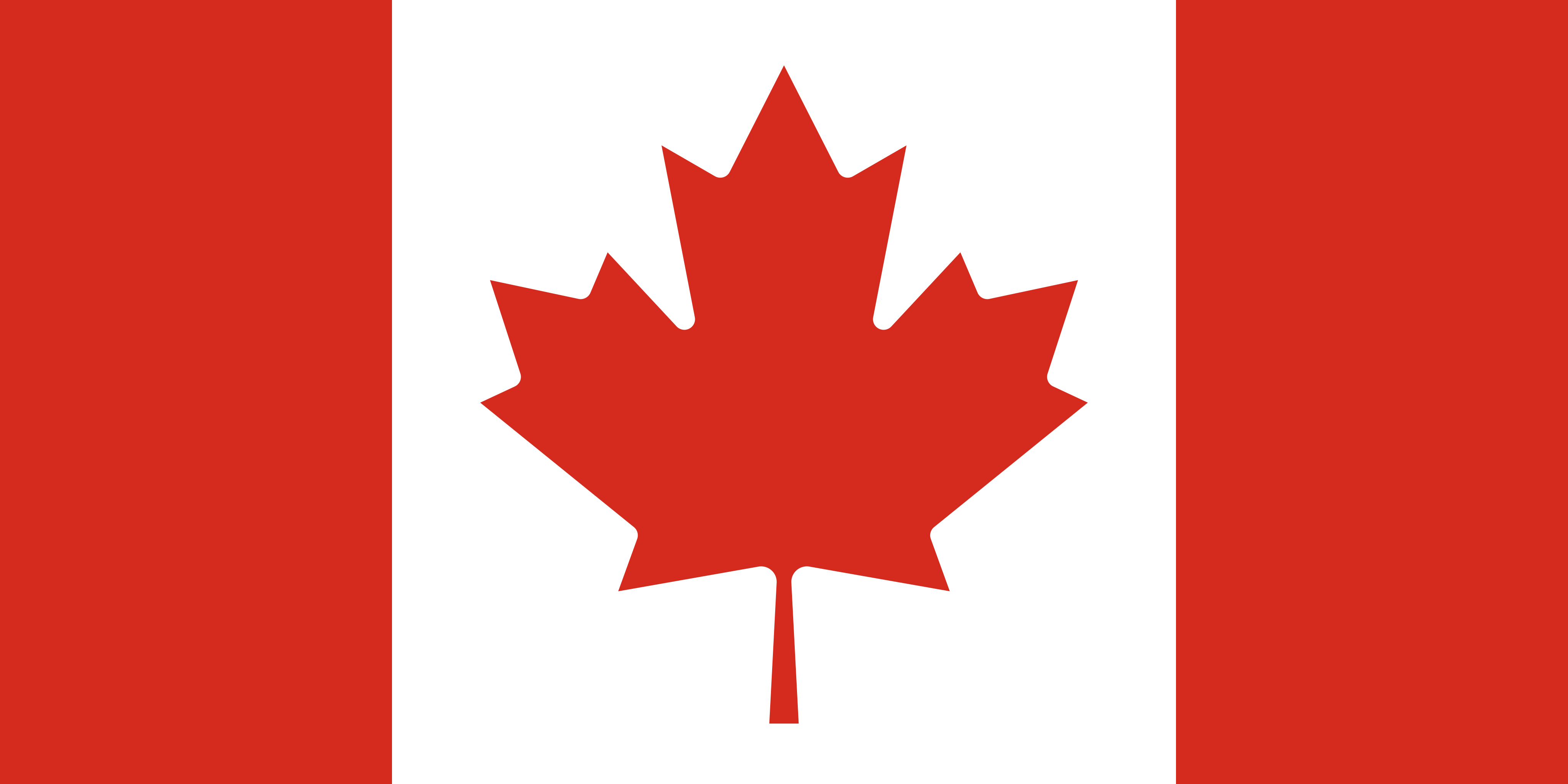
The Canada men's national football team represents the maple leaf country in international competitions. Managed by the Canadian Soccer Association, the selection has experienced remarkable development in recent years.
Nicknamed the Canucks or Les Rouges, Canadian players were long considered a modest CONCACAF team. However, Canadian football has experienced a true revolution in the 21st century with the emergence of a golden generation of players.
Canada has participated in two World Cups (1986 and 2022), with the latest qualification marking the selection's return to the world stage after 36 years of absence. Qualification for Qatar 2022 was a historic moment for Canadian football.
The selection plays in various stadiums across the country, notably at BMO Field in Toronto and BC Place in Vancouver. The country has modern infrastructure thanks to organizing the 2026 World Cup co-hosted with the United States and Mexico.
Among emblematic players are Alphonso Davies, Bayern Munich star, Jonathan David, prolific striker, and legends like Dwayne De Rosario and Julian de Guzman who paved the way.
FAQ
The Canadian team plays home matches in different stadiums across the country, primarily at BMO Field in Toronto (30,000 capacity) and BC Place in Vancouver (54,000 capacity). The country has excellent infrastructure for the 2026 World Cup it will co-host.
Canada's team was founded in 1912 but long remained in ice hockey's shadow. Canadian football experienced a turning point in the 1980s with qualification for the 1986 World Cup. After several difficult decades, MLS creation and a talented generation's emergence propelled Canada to CONCACAF's summit.
Canada won the Gold Cup in 2000, their biggest international title. The selection participated in two World Cups (1986, 2022) and finished first in their CONCACAF qualifying group for Qatar 2022, ahead of the United States and Mexico, a historic performance.
Alphonso Davies, Bayern Munich defender considered the best Canadian player in history, leads the current generation. Jonathan David (striker), Cyle Larin (scorer), Atiba Hutchinson (historic captain), and legends Dwayne De Rosario and Christine Sinclair (world's most capped female footballer) are prominent figures.
Yes, Canada will be automatically qualified for the 2026 World Cup as co-host with the United States and Mexico. This will be Canada's third World Cup participation and a major opportunity for football development in the country.
The nickname Les Rouges (The Reds) references the dominant red color of the Canadian jersey, inspired by the national flag's maple leaf. Players are also called the Canucks, a familiar term designating Canadians. These nicknames reflect national pride.
Canada's traditional colors are red and white, reprising the national flag's colors. The home jersey is generally red with white details, while the away jersey is white with red touches. The maple leaf is always present on the jersey.
Canadian football is experiencing explosive growth thanks to several factors: MLS clubs presence (Toronto FC, Vancouver Whitecaps, CF Montréal), star players' emergence in Europe, and future 2026 World Cup organization. The number of registered players is rapidly increasing and professionalism is developing.
Canada's best World Cup performance dates back to 1986 in Mexico, where the team participated in the group stage without winning matches or scoring goals. In 2022 in Qatar, Canada scored their first World Cup goal but didn't advance past the group stage.
The Canadian team has had several coaches recently. John Herdman led the team to historic qualification for Qatar 2022 before departing. The coach position is strategic for maintaining Canadian football's positive momentum toward 2026 and beyond.