

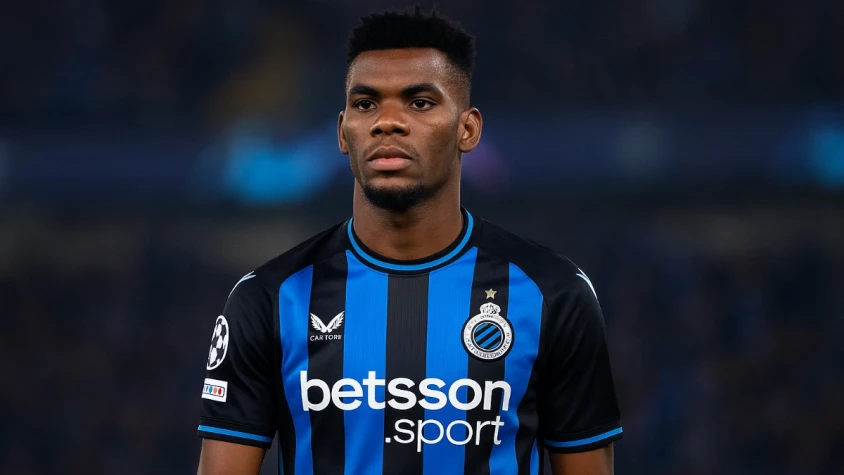
There is a particular loneliness to being an anchor in a sinking ship. As Arsenal's waves of pressure crashed against Club Bruges on Wednesday night, Raphael Onyedika stood firm in the middle of the Jan Breydel pitch, completing passes, winning duels, doing everything within his considerable powers to stem the tide. It was not enough. It was never going to be enough. But the 23-year-old Nigerian's performance deserved recognition amid the wreckage of a 3-0 defeat.
A warrior in the engine room
The statistics tell part of the story. Seventy-four minutes on the pitch. A 91% pass completion rate. One key pass created. Numbers that, in isolation, suggest a midfielder doing his job with quiet efficiency. But numbers cannot capture the reality of facing an Arsenal side that has turned the Champions League into their personal playground this season – five wins from five before kick-off, fourteen goals scored, just one conceded.
Alongside Aleksandar Stanković in Bruges' double pivot, Onyedika had been tasked with an almost impossible mission: disrupt Martin Ødegaard, contain the relentless movement of Mikel Arteta's interchanging attackers, and somehow provide a platform for his own team to threaten. For long stretches, particularly in a first half where the hosts created occasional moments of promise, the FC Ebedei academy product held his ground admirably.
His pressing was intelligent, his positioning sound. When Arsenal's intricate passing combinations threatened to slice through the Belgian defence, it was often Onyedika who appeared to snuff out the danger. The problem, of course, was that Arsenal simply had too many weapons, too much quality, too much of everything that separates Europe's elite from those who aspire to join them.
The weight of absence
What makes Onyedika's situation particularly poignant is the knowledge of what comes next. In four days, the midfielder will leave Bruges to join up with Nigeria's Super Eagles for the Africa Cup of Nations in Morocco. He will swap the December chill of West Flanders for the heat of North African competition, representing his country on the continent's grandest stage. It is an honour, undoubtedly. But for Club Bruges, it represents a crisis.
The Belgian champions face La Gantoise on December 21st and Racing Genk on Boxing Day – two fixtures that could define their title defence. Onyedika will be absent for both. Should Nigeria progress deep into the tournament, as many expect them to do, he could miss the crucial early weeks of January too. For a club already reeling from the recent dismissal of Nicky Hayen and still finding their feet under new manager Ivan Leko, losing their midfield anchor at such a moment feels like particularly cruel timing.
Those who have watched Bruges this season understand what Onyedika brings. He is the player who allows Hans Vanaken to drift forward and create. He is the shield that protects a defence already stretched by injuries and inconsistency. He is, in short, the kind of midfielder every successful team needs but few truly appreciate until he is gone.
A glimpse of the future
If there was a silver lining for Bruges supporters on this chastening European evening, it came in the form of another Nigerian connection. Kaye Furo, the 18-year-old son of former Super Eagles defender Iyenemi Furo, made his Champions League debut when he replaced Nicolò Tresoldi in the 67th minute. The teenager, who has already opened his account in the Belgian Pro League this season, announced himself with a shot that forced David Raya into a sharp save.
It was a small moment in a match dominated by Arsenal's clinical excellence – Noni Madueke's thunderbolt, Gabriel Martinelli's curling finish – but it spoke to something important. Nigerian talent continues to flow through Club Bruges, a pathway that has served both club and country well over the years. As Onyedika prepares to depart for continental duty, young Furo waits in the wings, eager to prove himself worthy of following in distinguished footsteps.
The bigger picture
For Onyedika himself, nights like Wednesday serve as both reminder and motivation. He arrived at Club Bruges from FC Midtjylland in 2022, a raw talent with obvious potential. Three years later, he has become integral to the Belgian champions, a player linked with moves to bigger leagues, a full international who will compete at AFCON with genuine hopes of glory.
The gap between Bruges and Arsenal was evident for all to see at the Jan Breydel. When Onyedika was withdrawn after 74 minutes, replaced by Hugo Vetlesen with the score already at 3-0, there was nothing more he could have done. Sometimes in football, as in life, you can perform your role with distinction and still find yourself on the losing side. The measure of a player is not always found in results but in the manner of their response to adversity.
In the coming weeks, Onyedika will have the chance to showcase his talents on a different stage. Morocco awaits, and with it the opportunity to help Nigeria claim a fourth AFCON title. The Super Eagles, for all their recent turbulence, possess enough quality to go deep in the tournament. Their midfield anchor from Bruges will be central to those ambitions.
What remains behind
Back in Belgium, Club Bruges must somehow navigate December and January without their most reliable central midfielder. The signing of new players in the winter window may help, but replacing what Onyedika provides – the reading of danger, the recycling of possession, the defensive intelligence – is easier said than done.
As the Nigerian walked off the pitch on Wednesday night, applauded by the Bruges faithful despite the scoreline, there was a sense of farewell hanging in the cold Flemish air. Not a permanent goodbye, one hopes, but certainly an extended absence at the worst possible time. For Raphael Onyedika, the adventure continues in Morocco. For Club Bruges, the hard work of coping without him begins now.